Open your weather app and look just under the temperature. There's a second number sitting there, and if it reads 34, or 41, or anything at or below 50, the air outside is rated good. That’s the simplest AQI meaning to remember: lower numbers mean cleaner outdoor air and fewer health concerns. On most days, that’s a positive signal to go ahead with the plans you already had.
Don't take that number for granted, though. It comes with an expiration time nobody prints on it. A green morning can slide into yellow by four in the afternoon, and nothing in your app will announce the change. So here's what a good reading actually buys you, when it quietly runs out, and who should keep watching it even when the color says everything's fine.
TL;DR Quick Answers
AQI Meaning
AQI stands for Air Quality Index, the 0 to 500 scale the EPA uses to report how much health risk outdoor air carries right now. Lower is cleaner. Whichever pollutant scores highest that day sets the number you see, so one pollutant drives the whole reading.
The scale: 0 to 500, split into six color-coded categories running from green at Good to maroon at Hazardous.
What counts as good: 0 to 50. Little or no health risk, and no advisory attached to any group.
What it measures: outdoor air only, across ozone, PM2.5, PM10, carbon monoxide, sulfur dioxide, and nitrogen dioxide.
It isn't a percentage: an AQI of 100 sits at the short-term national health standard, not at 100 percent polluted.
It moves during the day: ozone builds through hot afternoons, so a morning reading isn't a promise about your evening.
Top Takeaways
Good means 0 to 50. The EPA treats that range as posing little or no risk to the general public, and no group carries an advisory at that level.
The index isn't a percentage. An AQI of 100 tracks the short-term national health standard for the worst pollutant that day. It doesn't describe a share of pollution in the air.
One pollutant sets the score. Six get measured separately and the highest value becomes the number you see, so a good day is usually a good day for one specific pollutant.
Green expires. Ozone builds through hot sunny afternoons, so a good morning reading can be moderate by evening. Check again before anything after work.
It measures outdoor air only. A green reading says nothing about the air already inside your house, which is exactly why it's the right day to open the windows.
Active people count as a sensitive group. Faster, deeper breathing raises the dose reaching your lungs, so fitness doesn't take you off the list.
What a Good AQI Means on the 0 to 500 Scale
The Air Quality Index runs 0 to 500 and breaks into six color-coded bands. Good is the first one. Zero through 50, colored green, and the EPA treats that range as posing little or no health risk to the general public.
Two things about the scale trip people up.
First, it isn't a percentage. An AQI of 100 doesn't mean the air is 100 percent polluted. It means the worst pollutant that day has climbed to roughly the short-term national health standard for that pollutant. So 50 isn't half-bad air. It sits well under the line.
Second, one pollutant sets the whole score. The index measures ozone, PM2.5, PM10, carbon monoxide, sulfur dioxide, and nitrogen dioxide separately, gives each its own value, and reports the highest one. If ozone reads 44 and everything else reads lower, your good day is really an ozone day. That distinction matters more than it sounds like it should, especially when you're also thinking about the causes of seasonal allergies, and I'll come back to it. If you want the full picture of how each of the six bands from 0 to 500 breaks down, the category view is worth reading once and keeping somewhere you'll find it again.
What a Good Number Actually Lets You Do
Exercise and outdoor workouts
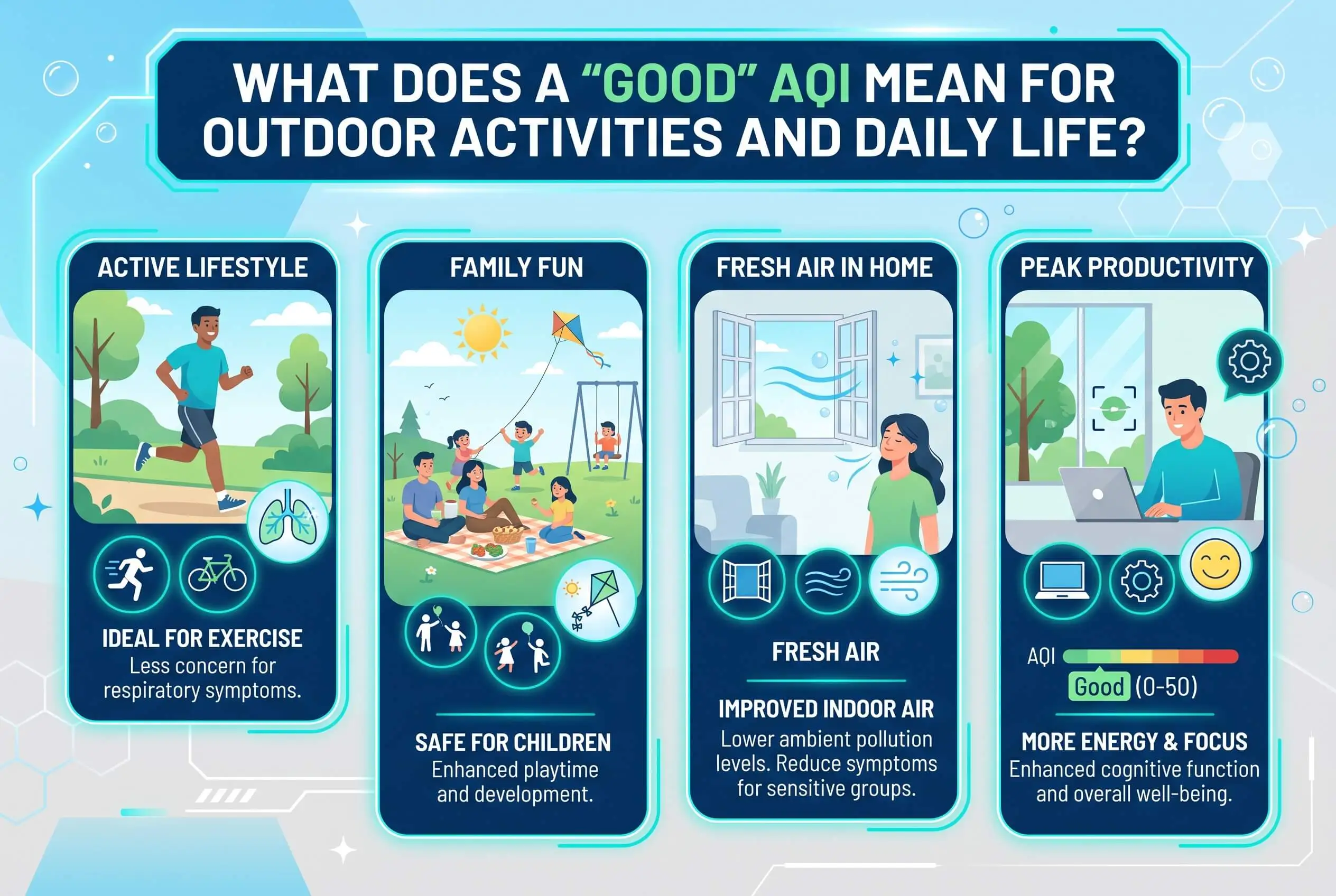
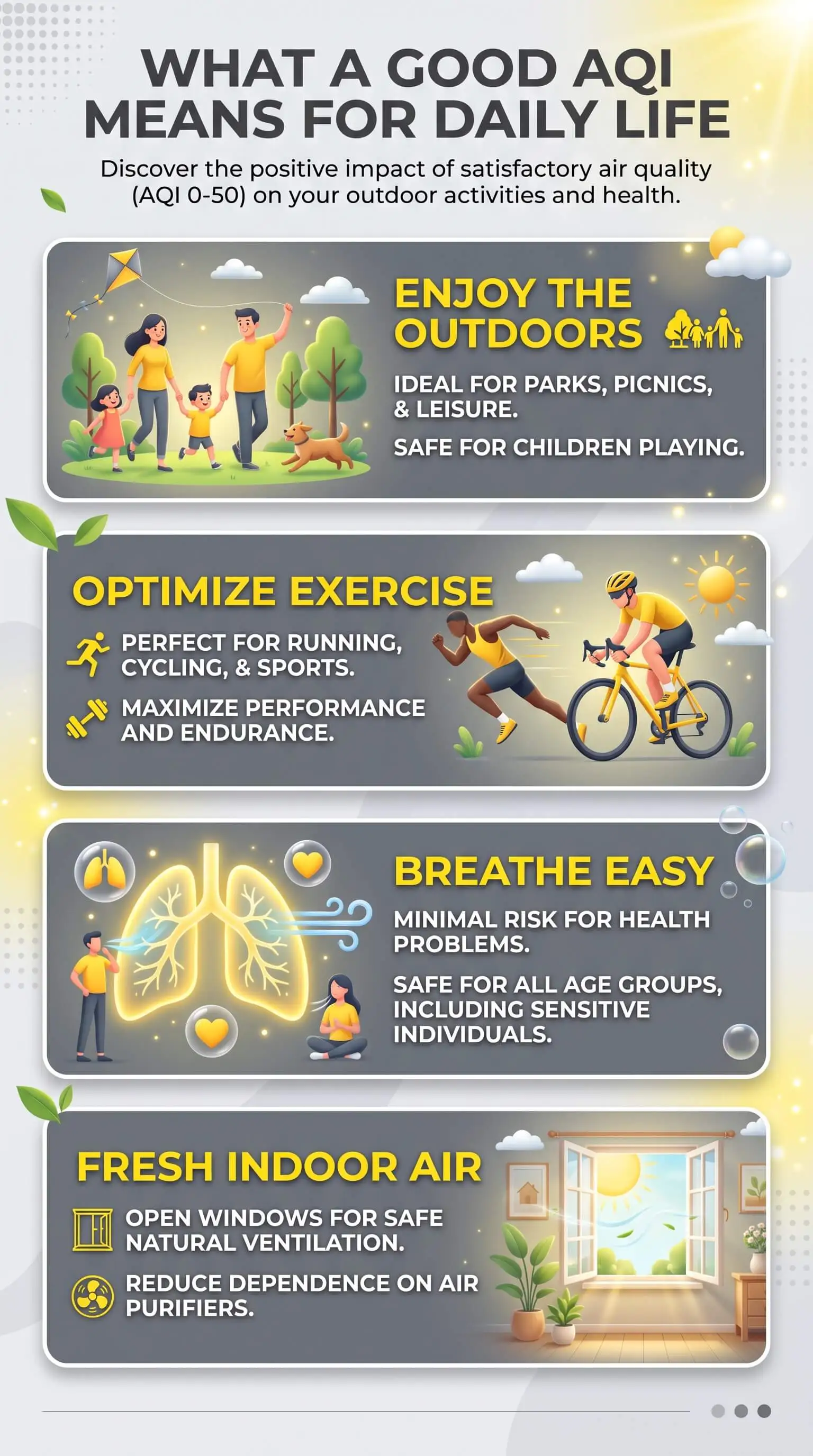
At or under 50, run, ride, lift outside, play a full game. Adjust nothing. Green is the only band on the whole scale with no advisory attached to any group, and federal physical activity guidance sends people to the index for exactly this call. A good reading is the clearest yes you're going to get out of it.
Errands, yard work, and time with the kids
Same answer, with one thing worth adding. If you've been putting off the long outdoor jobs like mowing, painting the fence, or a full afternoon at the park, schedule them for a green day. Your total exposure comes down to how many hours you spend out there, and a good reading is what makes a long stretch outside cheap.
The indoor job a good day is made for
Here's something that might surprise you. The index measures outdoor air only. It tells you nothing about the air in your living room, and on any given day the air inside a closed house can be worse than the air outside it, because cooking fumes, cleaning products, dust, and pet dander keep piling up with nowhere to go.
That's the part you can't see, and it's the part a green day fixes for free. A good outdoor reading is the best signal you'll get to open the windows and flush the place out. I treat it as a standing rule: good number, windows open, fan running. Once the number climbs later in the week that option closes, and you're back to relying on whatever your filter catches.
Why a Good Morning Reading Can Turn Yellow by Late Afternoon
Nothing emits ozone directly. It forms when sunlight cooks the emissions coming off traffic and industry, so it builds through hot sunny afternoons and falls back once the sun goes down. The same street corner can read good at eight in the morning and moderate by five in the evening.
Your app is also doing one of two different jobs, and it rarely tells you which. A forecast predicts tomorrow's value and usually goes out the afternoon before. A current reading runs a weighted average of recent hourly measurements that leans hardest on the newest data, so it moves fast when conditions do. Neither one promises you anything about six hours from now.
Pro Tip: if the plan is an evening run or a kids' game after school, check the number again before you walk out the door. When ozone is driving the score, morning is the better window, and top HVAC system repair can help keep indoor air systems performing properly when outdoor air quality changes.
Who Should Still Pay Attention When the Air Is Good
The EPA puts people who are active outdoors, including outdoor workers, on the at-risk list for ozone right alongside people with asthma, children, and older adults. The reason is dose. Working hard means breathing faster and deeper, so an active person pulls more air, and more of whatever's floating in it, further down into the lungs than someone sitting still.
Children carry extra risk because their lungs are still growing and they spend more of the day outside. And some perfectly healthy adults are simply more sensitive than average, for reasons nobody has fully worked out yet.
If you live with asthma, COPD, or a heart condition, treat a green reading as a good sign rather than a clearance. Your own symptoms are better data than the index is. Talk with your doctor about where your personal line actually sits.
How Other Countries Define a Good Reading
Every country sets good against its own national standard, not against some absolute measure of clean air. Canada reports a health index scaled 1 to 10 and up. The UK runs a ten-point index grouped into four bands. Australia, India, and several Asian countries each use their own breakpoints and their own category names. A side-by-side look at the national air quality indices used around the world makes the point in about thirty seconds. Same air, different label, depending on where you happen to be standing.
Glossary
Air Quality Index. The 0 to 500 scale the EPA uses to report outdoor air pollution and the health risk that comes with it.
PM2.5. Fine particles 2.5 micrometers across or smaller, small enough to travel deep into your lungs.
PM10. Bigger airborne particles, including dust and pollen.
Ground-level ozone. The main ingredient in smog. Sunlight reacting with vehicle and industrial emissions creates it.
NowCast. The weighted average of recent hourly readings behind the current AQI value.
Sensitive groups. Children, older adults, people with heart or lung conditions, and people active outdoors.
National Ambient Air Quality Standards. Health-based federal limits for six pollutants. An AQI of 100 lands roughly at the short-term standard.
Action day. A day when an air agency asks the public to voluntarily cut back on emissions.
“The reading people misuse most is a good one, because they assume it holds all day. On a hot summer afternoon I've watched the same monitor climb from the high thirties at sunrise into the sixties by late afternoon, purely on ozone forming in the sunlight. If you're planning something for the evening, treat the morning number as history rather than forecast.”
7 Essential Resources
1. Every AQI Category, Defined in Plain English
Source: AirNow, U.S. Environmental Protection Agency.
https://www.airnow.gov/aqi/aqi-basics/
All six bands with the health language attached to each one. This is where the 0 to 50 good range gets defined, along with the five pollutants the index covers.
2. How to Tell a Forecast, a Current Reading, and a NowCast Apart
Source: AirNow, U.S. Environmental Protection Agency.
https://www.airnow.gov/aqi/aqi-basics/using-air-quality-index
Explains why the number shifts through the day and which version you're actually looking at. Read it if you've ever seen two different AQI values for the same city in the same hour and wondered which one to believe.
3. What Ozone and Particle Pollution Do Inside Your Body
Source: AirNow, U.S. Environmental Protection Agency.
https://www.airnow.gov/air-quality-and-health/your-health/
A short, readable rundown of the symptoms each pollutant causes and who feels them first. Handy for deciding whether that scratchy throat after a run is worth noting.
4. Why Being Fit Doesn't Take You Off the Sensitive Groups List
Source: U.S. Environmental Protection Agency.
https://www.epa.gov/ground-level-ozone-pollution/health-effects-ozone-pollution
The federal page naming people active outdoors as an at-risk group in their own right. Worth ten minutes if you've been assuming good fitness cancels out exposure.
5. Category-by-Category Activity Advice Written for Families
Source: American Lung Association.
https://www.lung.org/clean-air/outdoors/air-quality-index
Turns each AQI band into a specific instruction for children, older adults, people who are pregnant, and people with respiratory disease. The most direct answer anywhere to “what do I actually do at this number.”
6. The Guidance Schools Use to Decide Whether Practice Goes Ahead
Source: U.S. Centers for Disease Control and Prevention.
https://www.cdc.gov/air-quality/media/Air_Quality_and_Outdoor_Activity_Guidance.pdf
One page, built for coaches and teachers, including the practical note that ozone runs lower in the morning. It works just as well for a parent planning a Saturday.
7. A Working Example of Turning the Index Into a Daily Habit
Source: AirNow, U.S. Environmental Protection Agency.
https://www.airnow.gov/air-quality-flag-program
Schools and organizations raise a colored flag each morning matching the day's AQI. It's the simplest model I've seen for building the same habit at home, and you don't need the flag to copy the idea.
These resources explain how AQI and individual pollutants affect daily air-quality decisions, while air ionizer installation can be part of a broader indoor air strategy when you want more control over the air inside your home.
3 Statistics
44% of Americans live where the air fails.
That's 152.3 million people in counties carrying failing grades for ozone or particle pollution. A good reading isn't the national default.
Source: American Lung Association, State of the Air 2026. https://www.lung.org/research/sota/key-findings
About 109 million people breathed air above federal limits in 2024.
Their counties exceeded the primary national standards. Air quality is local, and so is your number.
Source: U.S. Environmental Protection Agency, Air Quality National Summary. https://www.epa.gov/air-trends/air-quality-national-summary
9 of 16 studies found short-term effects from exercising in polluted air.
Reduced lung function showed up most often across an EPA review of the research. That's why the green band matters to athletes specifically.
Source: U.S. EPA Office of Research and Development. https://www.epa.gov/sciencematters/should-you-exercise-outside-air-pollution
These statistics show how widespread poor air quality can be and why reducing indoor particle exposure matters, with MERV 8 pleated HVAC furnace air filters helping capture common airborne particles inside the home.
Final Thoughts and Opinion
Most people use this number as an alarm. They check it when the sky looks wrong or the news mentions smoke, then ignore it the other fifty weeks of the year. I think that throws away most of what it's good for.
A green reading isn't a non-event. It's the day to book the long hike, let the kids stay out until dinner, air the house out properly, and finally knock out the outdoor jobs you've been pushing since spring, while high quality filters help keep the air inside your home cleaner. Those days are finite. In a lot of the country they're getting rarer rather than more common.
So here's my honest position after years of watching this number: it works better as a green light than a red one. Check only for bad news and you'll catch every day worth hiding from while missing every day worth going outside for.
Frequently Asked Questions
What is a good AQI number?
Anything from 0 through 50. That range is labeled good and colored green, and the EPA treats it as posing little or no health risk to the general public. Normal outdoor activity is fine for everyone at that level, with no group-specific advisory attached to it.
Is an AQI of 50 safe for everyone?
For the general public, yes. Fifty sits at the top of the good band and still lands well under the health-based national standard. People with severe asthma or a heart condition sometimes notice symptoms at lower values than average, so trust your own experience if it disagrees with the label.
What AQI is safe for running outside?
Anything at or below 50 needs no adjustment at all. Above 100, sensitive groups should scale back, and runners land in that category because harder breathing raises the dose reaching the lungs. Check the number again if you're heading out in the evening, and keep the main benefits of using UV lіghts in mind for supporting cleaner indoor air.
Does a good AQI mean my indoor air is clean?
No. The index measures outdoor air only. Pollutants from cooking, cleaning products, dust, and pets build up indoors on their own, and indoor concentrations can run higher than outdoor ones. A green day is a good reason to open the windows, not a report on the air already inside.
What time of day usually has the best air quality?
Morning, when ozone is the pollutant driving the score. Ozone forms in sunlight and peaks through hot afternoons and early evenings. Particle pollution behaves differently and can run high at any hour, especially near busy roads during rush hour.
Can the AQI be good and my asthma still act up?
Yes. Sensitivity varies from person to person, and pollen, humidity, temperature, and how hard you're working all sit outside what the index measures. Track how you feel against the number for a few weeks, use pleated furnace filters to help manage indoor particles, then bring that pattern to your doctor.
CTA
A Good AQI Is the Simplest Planning Tool You'll Use All Day, and Reading It Takes About Two Seconds. Check the Number, consider a test of indoor air quality when you want a fuller picture at home, Then Go Spend the Day the Way You Wanted To.